
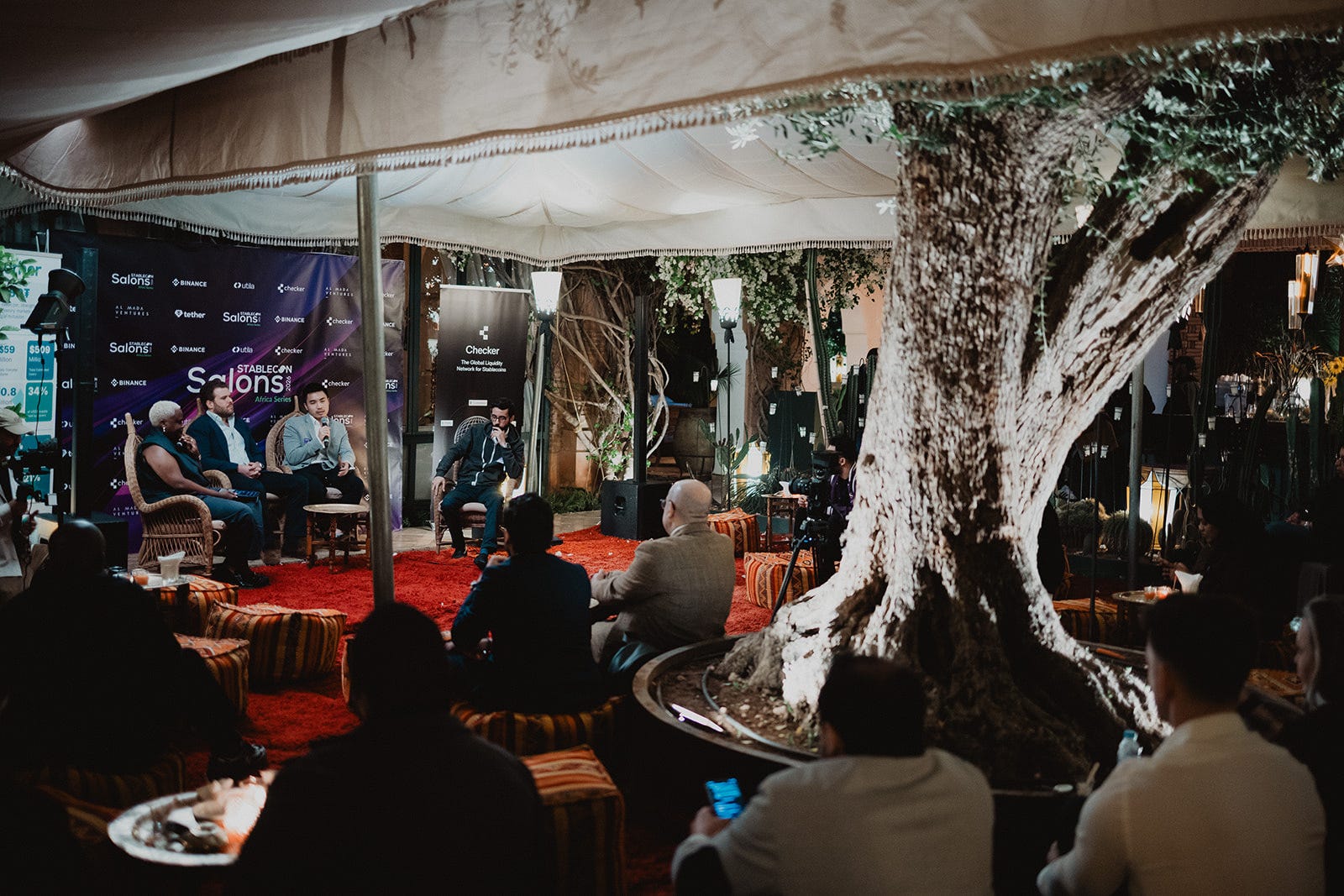
An engaged crowd at the Marrakech Edition of the Stablecon Salons Africa, held on April 7th 2026 in Morocco.
There is a particular kind of exhaustion that comes from watching an important word get hollowed out.
AI, Web3, Blockchain.
The tech industry has a gift for taking something genuinely significant and repeating it so many times in pitch decks, panel discussions, LinkedIn posts that it stops meaning anything. The word becomes a signal of nothing.
Stablecoins are deep in that territory now.
Somewhere between the tenth headline and the twentieth LinkedIn post, it stops landing. You’ve seen it everywhere in 2026; in earnings calls, in regulatory briefings, in conversations at dinners where someone starts explaining it and you nod until they stop. The word becomes noise and when something becomes noise, even the people it matters most to start tuning it out.
That is how important things get missed. Not because they weren’t real, but because the noise became indistinguishable from everything else.
But here is what keeps me paying attention: buzzwords die. The problems that created them don’t.
AI became a buzzword because something genuinely shifted in how machines process information. Stablecoin is the same story except in Africa, the cost of missing it is not abstract. It is measured in fees, in days and in economic activity that never happened.
That said and this is worth saying plainly not every project that promised to solve that problem has been delivered. The graveyard of stablecoin initiatives that launched with ambition and stalled on execution is real. Scepticism earned through experience is not scepticism to dismiss.
What has changed in 2026 is the nature of what’s being built and by whom.
The regulatory frameworks stopped being drafts. The US now has its first comprehensive federal stablecoin law, the GENIUS Act with the OCC and Federal Reserve finalising implementation rules this year. Europe’s MiCA framework moved from legislation into enforcement. Kenya’s VASP Act became operational. Rwanda’s Cabinet approved its VASP framework in March. South Africa’s FSCA extended its licensing regime to digital asset service providers.
Laws, Not drafts, Not proposals; Laws!
And when you have laws, the question changes. It is no longer whether stablecoins will become financial infrastructure. It is who builds that infrastructure, under what rules, and with what understanding of the markets they are building for.
That question lands differently in Africa. Stablecoins now account for 43% of all crypto transaction volume in sub-Saharan Africa. The global stablecoin market crossed $300 billion in early 2026. Daily settlement volumes now surpass $150 billion. Not because Africans are crypto enthusiasts because a remittance from Lagos to Nairobi still takes three to five business days through traditional banking at six to eight percent of the transfer. The stablecoin alternative completes in sixty seconds at under two and a half percent. People adopt what works. They always have.
The last mile problem is real and worth naming honestly. On-ramps and off-ramps, local currency conversion, the liquidity infrastructure connecting digital rails to everyday financial life it is still being built. In 2026, companies like NALA, Yellow Card, and Flutterwave are deploying that infrastructure at scale across African corridors, and the progress is measurable. But it is not finished. Anyone telling you it is solved is not being straight with you.
That is the problem the word is trying to name. It is real, structural, and being built on right now faster than the narrative is tracking it.
The question worth asking the one that never gets answered in a keynote is what it actually takes to close the gap between infrastructure that exists and infrastructure that works inside real institutions with real compliance requirements, real audit exposure, and real boards asking hard questions about counterparty risk and liability.
That is a different, harder, more human problem than building the rails.
I’ve spent four months in rooms trying to answer it.
Three Rooms, Three Honest Accounts
Since February I have hosted three editions of Stablecon Salons Africa Nairobi, Kigali, Marrakech with ecosystem partners including Binance, Tether, Utila, and Checker, and rooms that have included treasury managers, regulators, compliance officers, infrastructure builders, and investors. Not people with theories, people with decisions to make, organisations to answer to, and real consequences for getting this wrong.
Here is what each city actually taught me.
Nairobi showed me that the biggest obstacle after regulation is psychology.
Kenya’s VASP Act was operational before we arrived. The frameworks existed. The people in that room were not debating whether stablecoins worked. They were sitting with a more human question: how do you reorganise an institution around infrastructure that behaves differently from everything that came before it?
Joan Gachanja, FX Manager Africa at Thunes, gave the room its clearest moment. When her company moved to stablecoin-settled flows, she expected friction. What she found was the opposite.
“Treasury stops being cyclical and becomes real-time. Once that mindset shift happens, the operational efficiency gains are significant.”
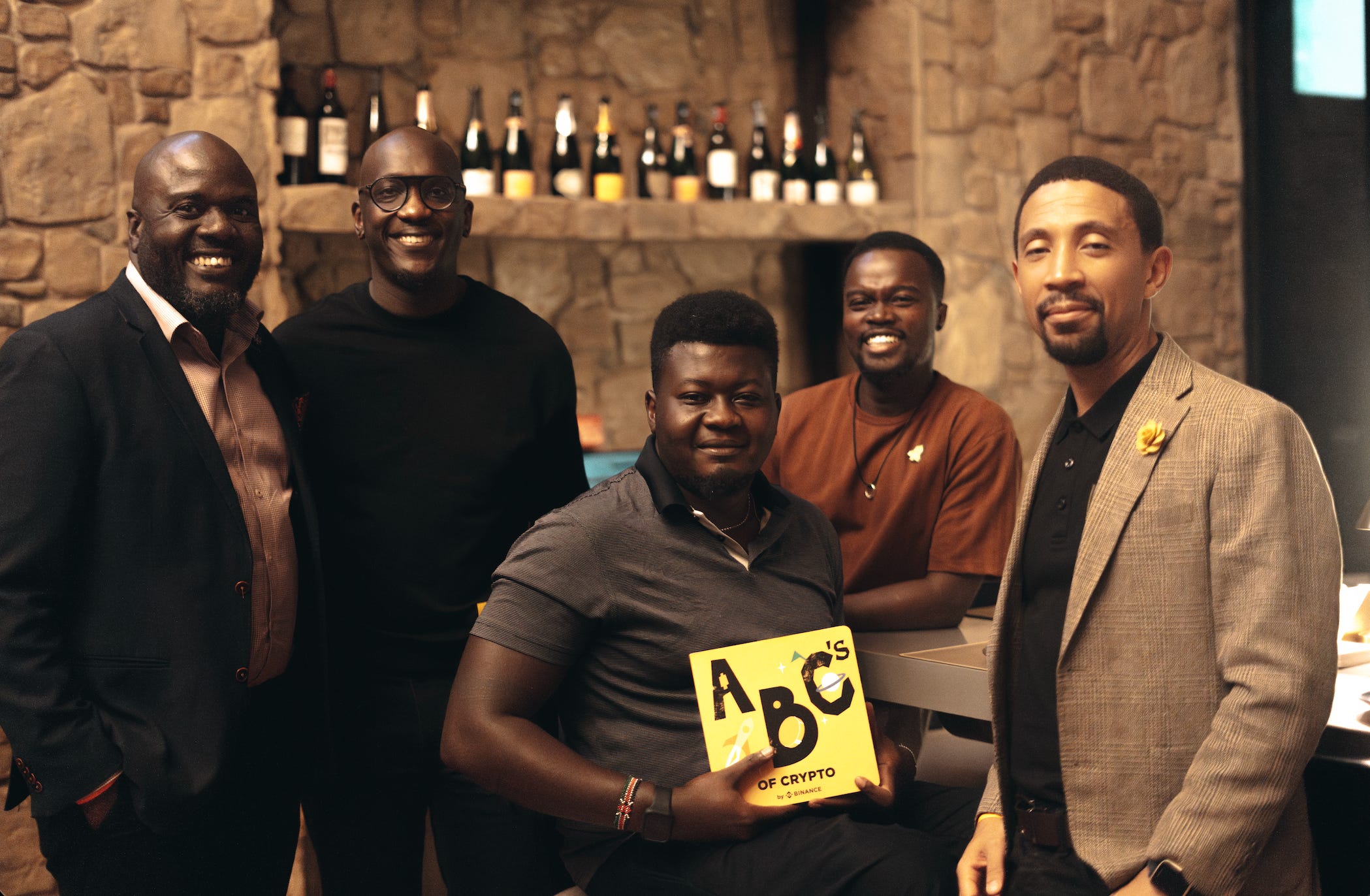
Members of Binance Africa’s team alongside stakeholders in Kenya’s virtual asset ecosystem at the maiden edition of the Salons in Nairobi. Left to right: Dr Peter S. Onyango (VAAK), Peter Mureu (BD Lead - Africa, Binance), James O. Hillary (CMA Kenya), Saruni Maina (Regional Operations Lead - Africa, Binance), Larry Cooke (Head of Africa Legal, Binance).
The difficulty, she was careful to say, was not the technology. It was that her team had built their entire operational model around the constraints of the old system: the float buffers, the timing windows, the assumption that money moves in cycles and observes banking hours. When those constraints disappeared, the model had to change. That is change management, not a software deployment. Slower, harder, more dependent on human behaviour. And the only way this becomes genuinely operational inside institutions.
Nairobi taught me: getting the regulatory work done is necessary. Human work is what comes next.
Kigali showed me what deliberate design looks like and revealed the specific gap it creates.
Rwanda’s Cabinet approved its VASP framework in March 2026. What the room surfaced was not celebration it was clarity about what that moment actually means. Norbert Haguma, Chairman of the Rwanda Blockchain Association, gave the most precise description of where deliberately-built markets now stand.
“We are in a post-regulatory phase. Not waiting for the rules anymore. Building within them.”
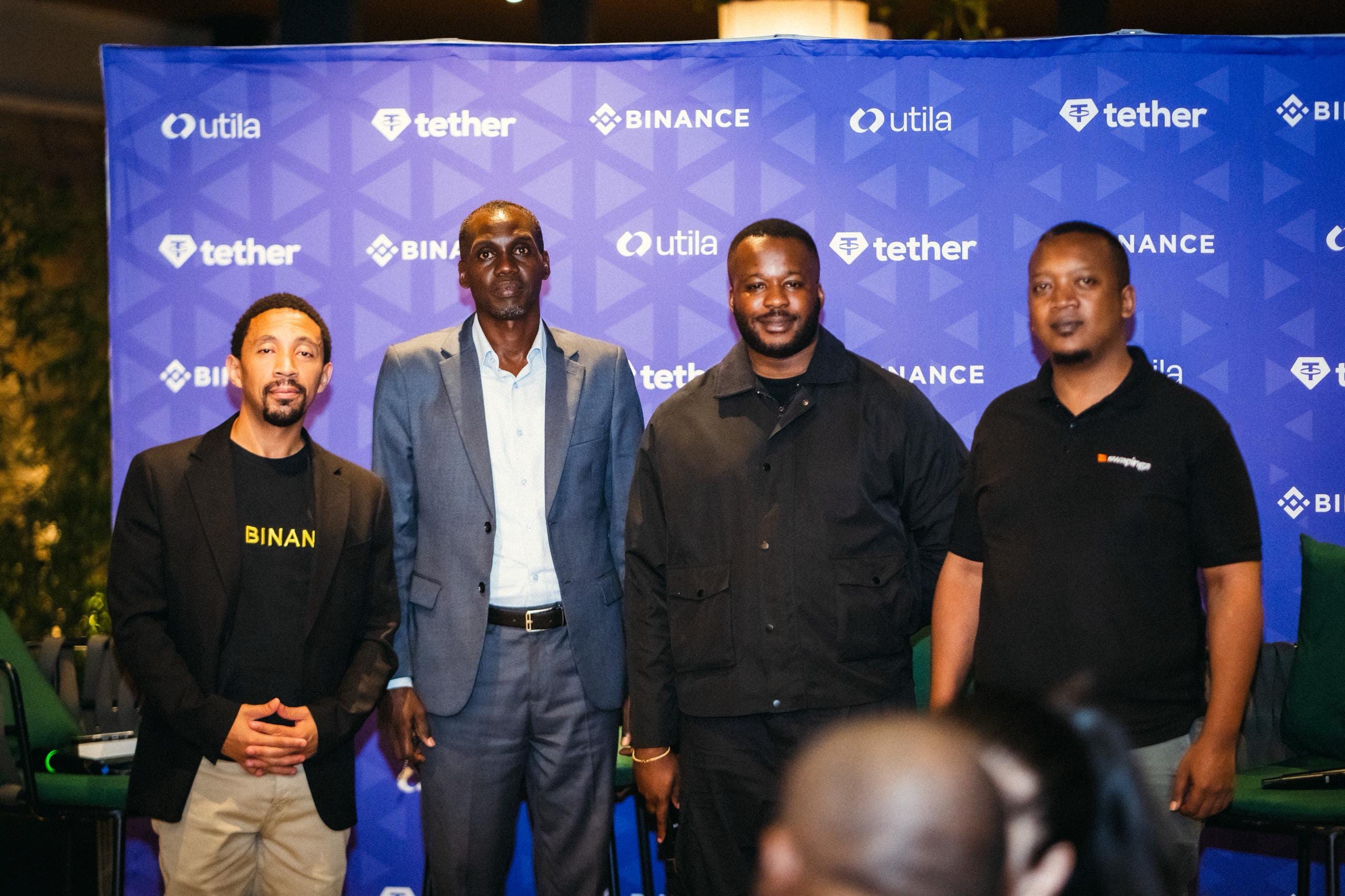
Left to Right: Larry Cooke (Head of Africa Legal, Binance), Jerome Ndayambaje (CMA, Rwanda), Paschal Okeke (Host, Stablecon Salon: Africa Series), Norbert Haguma (Chairman, RBA)
But he was equally direct about what that phase reveals. Rwanda has a licensing framework. What it does not yet have is the professional services ecosystem that framework requires around it. In traditional finance, that layer is invisible; it has existed for decades. Accountants who understand banking regulation. Lawyers who specialise in financial services. Valuators accredited for financial assets. The stablecoin equivalent is nascent or absent across most African markets.
He called it the “Tokenization Services Layer”, licensed platforms exist. The fifty service providers those platforms need around them are still being built. The next frontier is not regulation or technology. It is institutional depth.
Kigali taught me: getting the framework right is round one. Building the ecosystem inside it is the longer game.
Marrakech is where the diagnosis became explicit.
We co-hosted with Al Mada Ventures, and Rida Chaoud framed what the room was there to do before we even started: jurisdictions and operators that get the rules right ahead of the curve don’t just reduce friction they become the default choice for where serious builders go. Morocco is testing that proposition in real time.
Morocco ranks in the top 30 globally on Chainalysis’s 2025 crypto adoption index approximately $12.7 billion in transaction flow despite a formal ban on crypto in place since 2017. That is not a projection, It is a market demonstrating what it intends to do the moment conditions allow it. When the regulatory framework catches up to that behaviour, what emerges will not be a new market. It will be a formalised one.
Two people arrived at the same conclusion from completely different directions.
Francis Ogbuka from Utila builds the infrastructure institutions use when they are ready to integrate stablecoin operations. His diagnosis was direct.
“The rails are there. The harder work right now is getting the institutions that need to run on them actually ready to do so.”
Larry Cooke from Binance spent years inside the South African Reserve Bank before crossing to lead legal for Binance Africa. He has watched crypto arrive at the institutional door from the inside. He knows what it looks like when an organisation does not know what to do with it.
“Decentralisation and democratisation are not features of crypto. They are the point of it. Process efficiency, cost reduction, and financial inclusion these are the rare minerals of the modern financial system. And they are genuinely hard to find anywhere else.”
Between them, the day ended with a diagnosis I have not been able to set aside.
The gap is not technical. It never was.
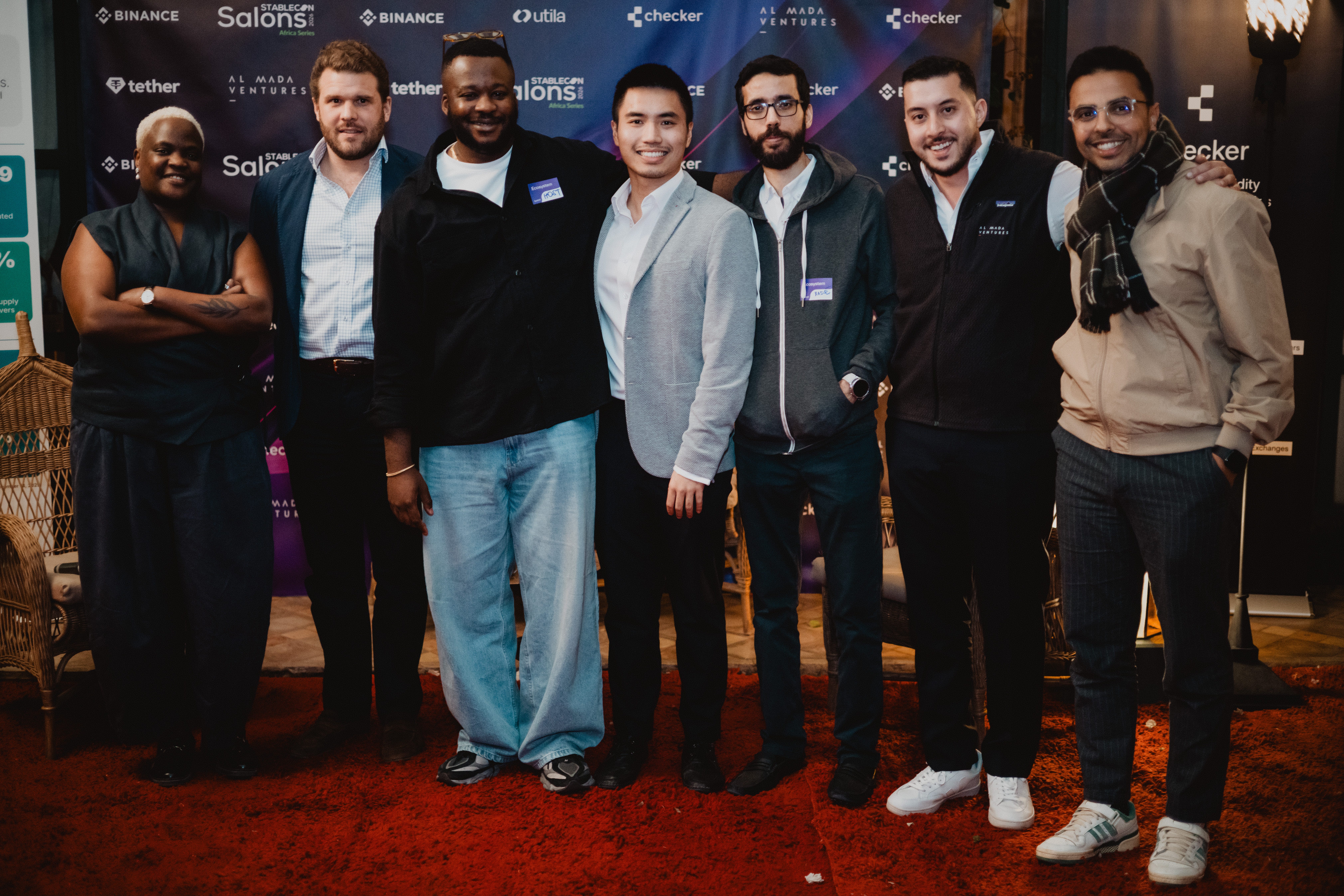
Left to right: Gwera Kiwana (Morse fka. Sling Money), Arnoud d’Yve de Bavay (Tether), Paschal Okeke (Host Stablecon Africa Series), Jack Chong (Checker), Badr Bellaj (Mchain), Ahmad Eladaoui (Al Mada Ventures), Rida Chaoud (Al Mada Ventures). Stablecon Salons Marrakech, April 7, 2026.
For every institution approaching stablecoins seriously for the first time in 2026, the technology is the easy part. The obstacle is internally the compliance team with no framework for evaluating a stablecoin settlement account, the board that needs language it doesn’t yet have, the risk function defaulting to no because no is safe in the absence of guidance. Closing that gap requires compliance language, risk frameworks, documented precedents, and internal education. Not more infrastructure. More understanding.
Marrakech taught me: this is the work that doesn’t get named in headlines but determines everything.
What the Ecosystem Has Been Confirming
The capital moving through this space in 2026 is saying the same thing the Stablecon Salon rooms have been saying.
Utila present since Nairobi closed over $40 million in funding while also joining the Mastercard Crypto Partner Program to expand its digital asset operations platform into Africa and emerging markets, nearly tripling its valuation Expansion capital for a company that has found what it is building toward.
In May 2026, Checker in the room across Nairobi and Marrakech announced an $8 million raise led by Al Mada Ventures, the same organisation that co-hosted Stablecon Salons Marrakech, alongside Galaxy Ventures, Framework Ventures, DFS Lab, and operators from Stripe, Flutterwave, and Tala.
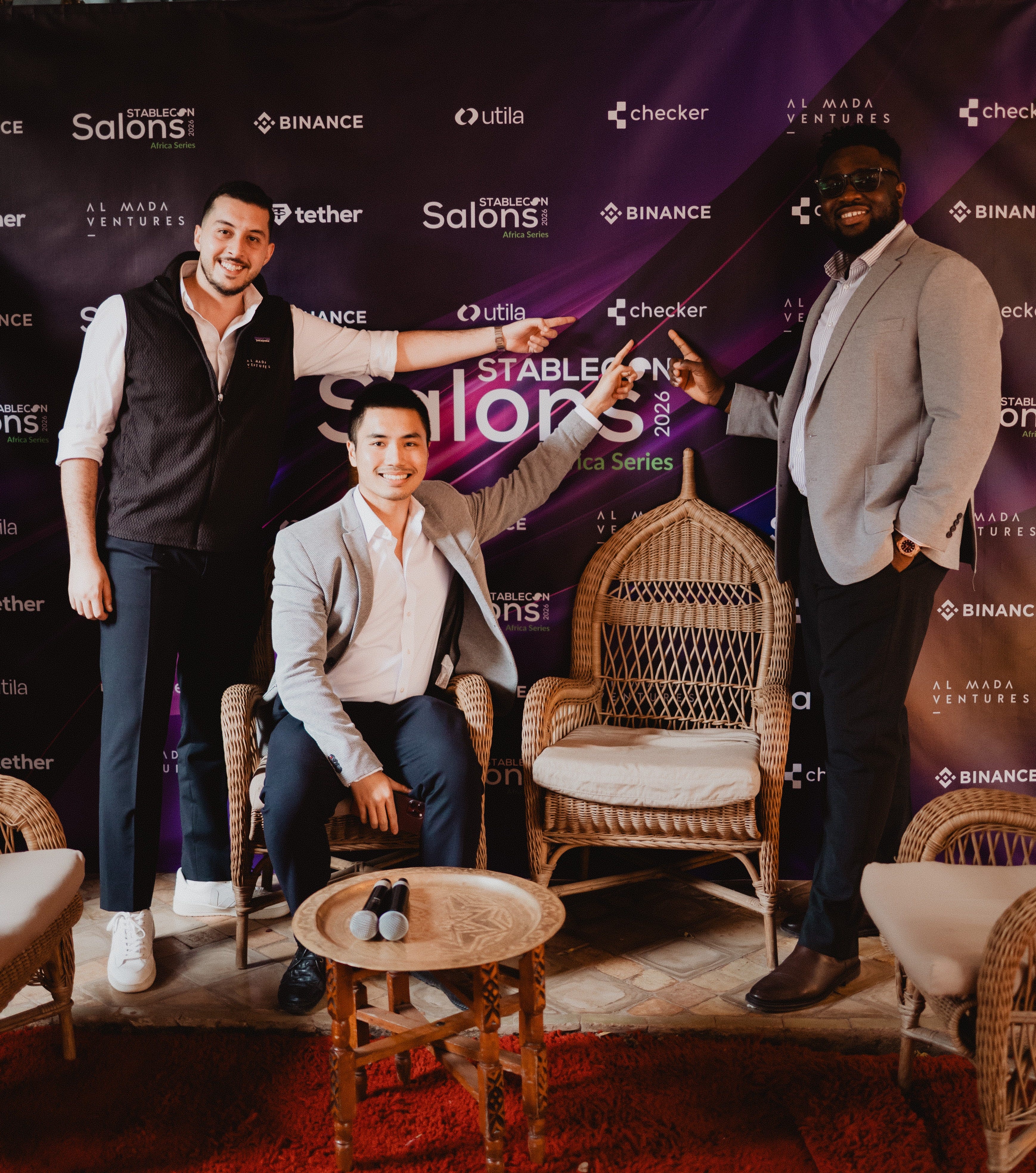
Left to right: Ameen Ahmad Eladaoui (Investments, Al Mada Venutres), alongside Jack Chong (CEO, Checker) and Isaac Umejiaku (Head of Africa Sales, Checker) at the recently concluded Stablecon Salons Africa in Marrakech, Morocco.
Tether recently invested in LemFi to promote Stablecoin-Powered Remittances across Africa and Emerging Markets.
The capital is being deployed to build the compliance tooling, audit infrastructure, and reporting layers that translate stablecoin operations into language institutions can act on. Precisely the gap these rooms have been naming.
Arnoud d’Yve de Bavay, who leads Africa expansion for Tether and has been part of this series since Kigali, put the trajectory plainly:
“Start with payments. Everything else follows.”
The use cases generating real commercial activity in 2026 are the ones eliminating existing friction cross-border payments, remittances, treasury flows rather than introducing new behaviour. The markets that skip the payments-first phase tend to stall. That pattern has held across all three cities, and it continues to hold in the capital allocation data.
I am not drawing a straight line between what happens in these rooms and where capital moves. I am noting that the people in these conversations and the people making these investments are, increasingly, the same people looking at the same gaps from different angles.
Why These Conversations Matter Now
There is no shortage of stablecoin events in 2026. The topic is loud, the capital is following, and wherever capital flows, panels appear. Most of them serve a purpose.
What they are not designed to do is surface the honest account of what isn’t working. On stage, nobody tells you that their compliance team spent four months trying to approve a stablecoin settlement account and still does not have a clear answer. Nobody names the specific gap in their organisation’s risk framework. Nobody asks the question they are genuinely afraid to ask in front of an audience.
Around a table, with people who have the same problem and enough trust to name it, those conversations happen. They are uncomfortable. They are specific. And they are the mechanism for closing the distance between what is technically possible and what is operationally real.
That is what these rooms are for, not to broadcast. To think and to build the shared understanding that turns regulatory clarity into operational clarity, one honest conversation at a time.
Whether you are convinced, sceptical, or somewhere honestly in between that is the only kind of room worth being in.
Johannesburg, June 2026.
The fourth edition. The first time the series comes home to the city where I’m building.
South Africa is one of the most institutionally developed digital asset markets on the continent. The FSCA’s licensing regime is further along than most and the practitioner depth is real. The questions this city brings into the room will be sharper and more commercially grounded than anything the series has produced yet.
The first three editions each arrived with a theme, Nairobi had one, Kigali had one and Marrakech had one.
Johannesburg has one too!
Come and find out, Register here.
If the conversations across the 3 cities (Nairobi, Kigali, Marrakech) left you wanting to go deeper, I recently published a white paper The Next Phase of Global Money Movement: An Operator’s 2026 Outlook on Liquidity, Control, and Infrastructure Through Africa that expands on a lot of what was discussed here.
Who Made This Possible
The last 3 editions of Stablecon Salons were made possible by our ecosystem partners who are each building infrastructure at the heart of the stablecoin economy.
Binance
Binance is the world’s largest crypto exchange by trading volume, with one of the most active Africa operations in the industry. From regulatory engagement to local market development, Binance has been a consistent presence across the continent’s digital asset ecosystem.
Tether
Tether: Pioneer in stablecoin technology and creator of USDT, the world’s largest and most liquid stablecoin. Tether is building accessible financial, AI, and energy infrastructure that bridges traditional finance and decentralized systems with a particular focus on empowering underserved communities across Africa and beyond.
Utila
Utila is a digital asset infrastructure platform built for fintechs and payment companies managing stablecoin flows at scale. Its modular approach letting companies assemble and switch between custody, compliance, liquidity, and yield providers rather than being locked into a single stack is designed for operators who have outgrown their first-generation setup.
Checker
Checker is a global network that enables financial institutions to access stablecoins and digital asset liquidity, cross-border payments, treasury, and credit via a single API. By streamlining integration and reducing operational complexity, Checker empowers teams to launch new financial products faster while unlocking new revenue streams.
Al Mada Ventures
Al Mada Ventures is a $110M Venture Capital fund investing capital in scalable, sustainable and innovative companies that have the power to reshape industries across the African continent. Born, bred and fuelled by a century-old African heritage & backed by 100% African capital, our ambition is to support visionary entrepreneurs to develop and scale transformative ideas for Africa and for the world.